Monday, May 22, 2017

THE BATTLE FOR THE BLACK BALLOT

Poll taxes, literacy tests, and other tricks for years were used by Southern States to disenfranchise black voters.  Starting near the turn of the century in the late 1890s states began to create all white party primaries.  Since there was no alternative to the Democratic Party nominee in the general election in most of the South, for all practical purposes, the Democratic Party Primary was the election.

Like many other Southern States, the Texas Democratic Party limited participation in its primary to white voters.  This little book, The Battle for the Black Ballot: Smith v. Allwright and the Defeat of the Texas All-White Primary, details the legal battle to abolish the all white primary.

Thurgood Marshall

Led by Thurgood Marshall, NAACP lawyers convinced the Supreme Court of the United States in 1944 that the all white Texas Democratic Primary stripped blacks of any meaningful right to vote.  This was a long hard road.  The book details the legal history which led up the decision and the litigation which followed the decision as Southern States continued to resist.  This is excellent reading.  Five out of five gavels.


Saturday, April 29, 2017

LEADING CASES IN THE COMMON LAW

Professor Brian Simpson (1931 - 2011) taught at the University of Michigan Law School from 1987 until his retirement in 2009.    A British citizen and a graduate of Oxford University, the Guardian said this about Simpson in 2011 its obituary following Simpson's death on January 10, 2011:

"Although his academic career was latterly spent mostly in the U.S., he remained a British liberal to his core and never became an American citizen.  He tended to spend the winter and spring in Ann Arbor, Michigan, but for the summer and autumn he was often at the then Public Record Office, now the National Archives, in Kew, west London.  He was elected a fellow of the British Academy in 1983, a fellow of the American Academy of Arts and Science in 1993, was visiting professor of legal science at Cambridge Universtiy 1993-94, and in 2001 was appointed an honorary Q.C."

The book under consideration, Leading Cases in the Common Law (1995) posits the thesis that there is no "science of law" and that leading cases must be studied in their historical and cultural context to really understand the rationale for the decisions. 

This is fascinating reading.  Starting with Wolfe v. Shelley (1581), which produced "The Rule in Shelley's Case" that generations of law students have been tortured with, Professor Simpson seeks to find the story behind the story.  Shelley's case did not really have anything to do with some philosophical rule regarding wills and deeds and had everything to do with Queen Elizabeth I and her government wanting to disinherit a wealthy Catholic recusant son in favor of the deceased's Protestant grandson who had the Queen's favor.  Of no real significance at the time, it only became "a leading case" because one of the winning lawyers, Edward Coke, reported the case in the series of case reports which he published.

Professor Simpson goes through and tells "the story behind the story" on a number of famous common law cases, beginning with Wolfe v. Shelley (1581) and ending with Carlill v. Carbolic Smoke Ball Company (1893) which generations of law students have been tortured with to understand the acceptance of unilateral contracts.

This is fascinating reading.  Every Anglo-American lawyer interested in the history of the Common Law should read this book.  Five out of Five gavels.

Alfred William Brian Simpson, Q.C. (1931 - 2011)

Professor A.W. Brian Simpson's last Michigan Law School class

Wednesday, April 5, 2017

A DEATH AT CROOKED CREEK


In Mutual Life Insurance Company v. Hillmon, 145 U.S. 285 (1892), the Supreme Court created an entirely new exception to the hearsay rule.  The rule that a statement of future intention by the declarant is not hearsay did not exist in the law of evidence prior to the Hillmon case.

John Hillmon

Hillmon involved a Kansas cowboy, John Hillmon, who left his new bride in the late 1870s to pursue establishing his own cattle ranch.  Before leaving his home in Lawrence, Kansas, Hillmon purchased $25,000 worth of life insurance from three different insurance companies.  ($25,000 was the equivalent of approximately $500,000 in current dollars.)  On the Kansas prairie, at a place called Crooked Creek, Hillmon was allegedly accidentally shot by his business partner.

Frederick Adolph Walters

Agents and attorneys of the insurance companies almost immediately sprang into action.  Although a coroner's inquest was held in Medicine Lodge, Kansas and determined that the dead man was John Hillmon and that he had died by accidental death, the insurance men had the body exhumed and brought to Lawrence where another inquest was held.  (It was later revealed that the county attorney, the coroner and the jurors had been paid by the insurance companies). This time, the coroner's jury found that the body was of an unknown individual who had been killed through foul play.

The corpse.  Is it John Hillmon or Hillmon's victim.


Sallie Hillmon, John's widow, filed suit in U.S. District Court against the insurance companies for breach of contract.  The insurance companies maintained that the corpse was actually the body of Frederick Adolph Walters, a cigar maker who had drifted to Kansas from Ft. Madison, Iowa.  Alvina Kasten, Walters fiancee had received a letter from Walters in which he told her that he was in Wichita and had been hired by a man named Hillmon to herd sheep because Hillmon had "promised me more wages than I could make at anything else."  Walters had disappeared and never been heard from again.  The insurance companies alleged that Walters had been killed by Hillmon and then passed off as Hillmon's body to collect the insurance proceeds.

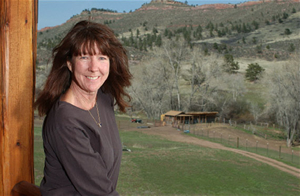
Professor Marianne "Mimi" Wesson

The case eventually resulted in six trials, two resulting in verdicts for the Plaintiff which were both reversed by the Supreme Court, and four hung juries.

Professor Wesson and friend.

This very interesting book was written by University of Colorado law professor Marianne "Mimi" Wesson.  Professor Wesson is also the author of a series of mystery novels.  Where the historical record is silent, Professor Wesson has filled in the gaps with fictional accounts of what may have happened.


The book also recounts the efforts of Professor Wesson to identify the body of the man who was killed at Crooked Creek and solve the mystery.  Gaining permission to exhume the body, DNA samples were obtained from the nearest living relatives of Hillmon and Walters.  Unfortunately, water had seeped into the grave and only bone fragments remained from which no usable DNA could be extracted.  However, an expert compared photographs of the living Hillmon and Walters with photographs of the corpse and concluded that although the body might be someone other than Hillmon,  it was definitely not Frederick Walters as contended by the insurance companies in the six trials.

Professor Wesson at the grave of John Hillmon

Professor Wesson concludes that the U.S. Supreme Court created an entirely new rule of evidence just because they didn't like the jury's verdict and wanted an excuse to overturn the case.  The rule has been heavily criticized in other cases.  Why does a statement of intention have more reliability than any other hearsay statement?  As one reviewer of this book has said, should the statement "I intend to do my homework tonight," really  be admissible as evidence to prove that I did my homework but the dog ate it?

A Death at Crooked Creek is a really good read.  Five out of five gavels.

Sunday, December 25, 2016

HISTORY OF AMERICAN LAW


Magnificent.  That's the best description I can give of Professor Lawrence Friedman's masterpiece.   If there is anything that Lawrence Friedman hasn't read about American legal history, I'd be surprised. From the first colonial settlements until the early years of the twenty first century, this book covers it all.


It would seem like this topic should be boring, but this is an engaging and engrossing book.  To a large extent the history of the American people is a history of their laws and legal systems.  Even the chapters about legal education and lawyers are not boring.


Why is all this important? "The law, said Justice Holmes, is a magic mirror, wherein we see reflected not only our own lives but also the lives of those who went before us.  Thus, a history of American law reflects the nation's history in all its manifold aspects.  Every important development in American life has had its impact on the law, from the founding of the Republic to the internal stresses of the society two centuries later."  Bernard Schwartz, The Law in America: A History (1974).

Five out of five gavels.

Saturday, July 23, 2016

THE SALEM WITCHCRAFT TRIALS: A LEGAL HISTORY


This excellent little book by University of Georgia History Professor Peter Charles Hoffer was first published in 1997.  Professor Hoffer was the author of an earlier book on the Salem Witch Hysteria which was much broader in scope.  As the title indicates, this book is a legal history which concentrates on the trials themselves.

Due to a number of factors, hysteria not only gripped Salem Village in 1692 but also the entire Massachusetts Bay Colony.  Ministers and Judges in Massachusetts had headed off earlier witchcraft accusations which, as in Salem Village, were made by teenage girls who claimed to be oppressed by the spirits of various members of the community.

The witchcraft accusations were, in part, fueled by animosity between the Putnams and the Porters, leading families in Salem Village, who were competing for land, wealth and control of village politics.  Judges in the early Salem Witch Trials ignored the rudimentary rules of evidence which were current in English law which prohibited the introduction of "spectral evidence," that is testimony regarding visions, dreams and ghosts.  When allegations were believed that the oppressed victim was being tormented by the spirit of a Defendant, the Defendants were powerless to refute it.

In the earliest trials, the Defendants were unpopular and outcast members of the community.  The accusations soon spread to respected older women, like Rebecca Nurse, a stalwart church member who was well respected in the village.  In fact, despite the introduction of spectral evidence and the rabid denunciations of the alleged victims, the jury initially returned a verdict of not guilty.  The judges, led by Massachusetts Bay Lt. Governor and Chief Judge William Stoughton, were enraged and sent the jurymen back to reconsider their verdict.  The jury then complied and brought in a guilty verdict and sent the respected Goodwife Nurse to the gallows.

At this time in English law, a criminal defendant was not allowed to be represented by counsel but was required to conduct their own defense.  A criminal defendant was not considered to be a competent witness and could not testify under oath, although they were allowed to make an unsworn statement to the jury.

The prominent Boston minister Cotton Mather was an enthusiastic proponent of the trials.  Mather somewhat backed off of this position after his distinguished father, Increase Mather, and a group of Massachusetts ministers urged the governor to end the trials and denounced the admission of spectral evidence.  Governor William Phips eventually ended the trials and pardoned those remaining in jail.  Chief Judge Stoughton, who eventually replaced Phips as Governor, was outraged and reportedly stormed off the bench saying "that he was just about to 'clear the land' of witches when Phips interfered."

This book is part of the series called "Landmark Law Cases and American Society" published by the University of Kansas Press.  This is excellent reading and is highly recommended.  Five out of five gavels.

Monday, February 8, 2016

JIM GARRISON'S BOURBON STREET BRAWL


This little book (150 pages including bibliography, notes and index) chronicles the U.S. Supreme Court's decision in Garrison v. Louisiana, 379 U.S. 64 (1964).

Jim Garrison was the controversial District Attorney of Orleans Parish, Louisiana who became famous (or infamous) when he indicted a New Orleans businessman, Clay Shaw, and claimed that he was a C.I.A. operative who had been involved in a conspiracy to assassinate President John F. Kennedy.

The events of this book happened in the early 1960s well before the prosecution of Clay Shaw.  Garrison became involved in a fight with local criminal court judges over the use of funds gathered from criminal bond forfeitures which Louisiana law allowed the District Attorney to spend with the permission of the judges.  When Garrison began his own sting operation on Bourbon Street in New Orleans, going around the New Orleans Police Department, the judges began refusing his request for funds from the forfeiture fund.

Garrison's sting operation primarily involved stopping a scam in Bourbon Street bars where a patron would be approached by one or more girls who implied that they would provide sex to the man "if he would buy her a drink."  The customer would then be asked to buy one or more bottles of over priced champaign.  After the customer was drunk, the bottles might only be filled with ginger ale.  When he was really drunk, he would typically be asked to leave and thrown out by a bouncer and sometimes by the New Orleans Police.   Garrison sent his investigators into the bars undercover and many Bourbon Street establishments were forced to close.

When the judges began to deny Garrison funding, he publicly accused the judges of being "racketeers," and implied that the judges were being bribed by the Bourbon Street Bar owners.  Garrison also accused the judges of being at fault for jail overcrowding for taking too many vacations and refusing to hold court.   In response, the Attorney General of Louisiana charged Garrison with Criminal Defamation.  Garrison was tried and convicted after a bench trial.

Orleans Parish District Attorney Jim Garrison

After Garrison's conviction was upheld by the Louisiana Supreme Court, Garrison appealed to the U.S. Supreme Court.  The Supreme Court had recently held in New York Times v. Sullivan that a public figure cannot recover damages for liable unless the statements were "malicious,"  The Court defined malice as "a reckless disregard for the truth."

Savage's thorough research using Justice William O. Douglas' conference notes brings us inside the Justices' conference and reveals the deal making which goes on behind the scenes among justices.  Ultimately, after the case was argued twice, the Court ruled that the Louisiana criminal defamation statute as written was unconstitutional and applied the New York Times v. Sullivan standard to criminal defamation cases.  

The colorful Attorney General of Louisiana, Jack P.F. Gremillion, apparently was never able to comprehend that at the level of the U.S. Supreme Court, what they were talking about was the constitutionality of the statute and not the guilt or innocence of Garrison.  Gremillion, who was a member of the Earl K. Long faction in Louisiana politics, had previously been held in contempt of court by a Federal Judge in New Orleans in a school desegregation case, telling the judge that the U.S. District Court was "a kangaroo court," and "a den of iniquity," and allegedly spitting at the black plaintiffs.  Gremillion's performance before the U.S. Supreme Court, according to Savage, resembled a stump speech more than it did a legal argument before the nation's highest court.

The book, Jim Garrison's Bourbon Street Brawl: The Making of a First Amendment Milestone, was apparently Savage's Master Degree Thesis.  I found it to be an enjoyable and informative read.  Five out of five gavels.